
Bioluminescence
in the Salish Sea
From May to September, upwelling currents and long daylight hours result in large algae blooms in the Salish Sea. Some of these microscopic organisms are called dinoflagellates. When disturbed, these tiny organisms emit flashes of light, creating a dazzling display beneath the waters surface. This phenomenon is called bioluminescence, or the creation of living light.
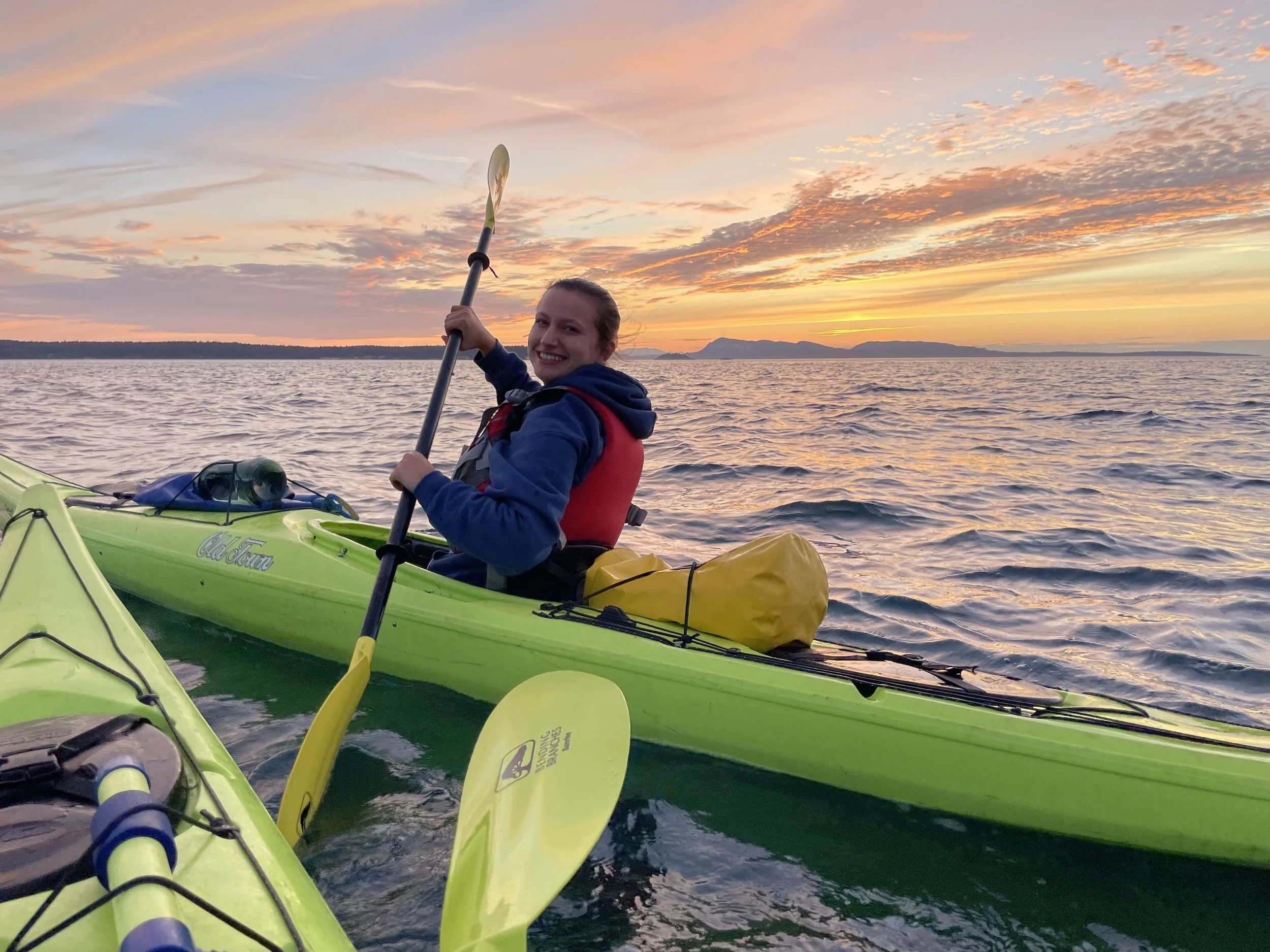
In 2022, the Community Boating Center and Western Washington University Marine and Coastal Sciences program partnered to ask some key questions about this incredible phenomena, and share information with the general public through our Bioluminescent Internship. To see the magic for yourself, book a Bioluminescence Paddle with The Community Boating Center.
How does Bioluminescence work?
“Like with fire, a chemical reaction using oxygen also causes bioluminescence. However, the reaction occurs without giving off much heat. Instead, almost all of the energy is released as visible light.
Bioluminescence is an enzymatic reaction. An enzyme speeds up the chemical reaction by helping a substrate react. The enzyme is reused in the reaction instead of being transformed into another molecule.
The enzyme in bioluminescent reactions is luciferase. The different substrates are called luciferins. Luciferase helps catalyze, or speed up, the chemical reaction between the luciferins and oxygen. During this chemical reaction, the luciferin molecule is oxidized, which forms light and a new molecule, oxyluciferin, which is inactive. After the chemical reaction, luciferase is recycled, which means it can continue to produce light in the form of bioluminescence so long as both luciferin and oxygen are present. This reaction can take place within an organism or in the water.”
NOAA says it best, so we’ll quote them here.

Other Bioluminscent Creatures…
The crosshatch jellyfish is often seen on our tours + is bioluminescent when disturbed. They don’t sting us, you can pick them up and get bioluminescent jelly slime on your fingers!
Illuminated in the bioluminescence, you can see marine mammals, small fish, barnacles feeding on pilings, and marine worms called polychaetes swimming near your boat at night! Keep an eye out.

Why do 76%-90% of deep sea organisms light up?
-
Have you seen Finding Nemo? The angler fish has a famous lure on its head to attract prey called an esca which houses specific bioluminescent bacteria, some unique to each species of anglerfish. Living thousands of meters below the surface, angler fish don’t come across other fish very often resulting in a bioluminescent lure, a very large mouth to body ratio to fit the largest prey and causing some species of anglerfish to mate by sexual parasitism. Where the tiny male anglerfish attaches to the side of the large female, eventually fusing into her body and connecting circulatory systems. The female has full control of when sperm is released and she can wait until conditions are optimal to fertilize her eggs.
-
Some sharks and other fish have a darker topside and a lighter bottom to camouflage with the water above and below called countershading. Animals use this same principle at night using bioluminescence called counter-illumination. Bioluminescent organs called photophores match their undersides to the moonlit water above with the exact same light intensity which is controlled and adjusted. This cookie cutter shark does that too except for one dark patch that may look like prey causing a bigger fish swim to it and the cookie cutter shark has dinner with a signature circular bite.
-
The pocket shark is so small it’ll fit in your pocket. As the cutest shark in the sea, this shark looks a little different from others and was recently identified in 2010. It's a deep living shark in the Gulf of Mexico that has bioluminescent liquid hypothesized to release it when threatened or to attract prey. It was found by folks studying sperm whales which is hilarious because it looks like a tiny sperm whale.
-
Some open ocean organisms use bioluminescence much like the firefly, to attract a mate. Ostracods are tiny crustaceans with a mating display known as the string of pearls, where the males vomit bioluminescence mucus strings and balls underneath them that the female ostracod finds and swims up. This phenomenon is a famous encounter for scuba divers around the Caribbean.
-
The stoplight loosejaw is a creepy looking deep sea fish with blue/green photophores like other fish we have discussed. This fish is spectacular because it also has red photophores which is interesting because red light is absorbed by water and virtually disappears after 15 feet. About 100 meters down, a red fish would be virtually invisible resulting in an inability to see red in most deep sea fish. The stoplight loosejaw hunts and communicates using a red light which is invisible to any other species. Shining its own invisible flashlight like a deep sea ninja.

Keep Exploring
This phenomenon in Bellingham Bay is still a mystery to researchers. They want your help
Bellingham Herald, 2022
Bioluminescence of the Salish Sea
Lucy Greeley, 2022
Bellingham Bay Bioluminescence
Carrley Smith, 2024
The Team
-

Lucy Greeley
As the first bioluminescence intern, Lucy’s research was a baseline study regarding community composition of planktonic species contributing to bioluminescence in Bellingham Bay. Using the light microscope to identify species presence and extracting DNA for amplicon sequencing, running PCR and gels.
-

Carrley Smith
Carrley focused on providing science education amid bioluminescence kayak tours while collecting environmental data and sampling the planktonic community responsible for producing bioluminescence. She compiled the majority of the information found for this website.
-

Eddie Nosal
Eddie began research questioning what bioluminescence could tell us about the overall health of an ecosystem. developed community partnerships with the Marine Resource Council and Department of Ecology. Throughout his internship, Eddie lead over 400 guests on bioluminescence paddles.
-

Lucy Ritter
Lucy partnered with Western Washington University to develop a bioluminometer and investigate how bioluminescence changes in response to seasonal patterns and environmental conditions.
Meet our 2026 Bioluminescence Intern…. Ginny!
Hello! My name is Ginny (she/her), and lm the Community Boating Center's 2026 Bioluminescence Intern!
I'm currently a senior at Western Washington University, where I'm pursuing a bachelor's degree in Environmental Science with a Marine emphasis. I'm passionate about marine ecology, science communication, and exploring the Salish Sea by kayak. I love helping people connect with the incredible ecosystems we have here in the Pacific Northwest.
As the Bioluminescence Intern, I have the unique opportunity to guide our Bioluminescence Paddles and serve as a naturalist on the water. I love getting to share both the science behind bioluminescence and the sense of wonder that comes with seeing the bay light up at night. Watching paddlers reactions the first time they see the water glow is one of the most rewarding parts of the experience and it never gets old!
I'm looking forward to sharing this incredible natural phenomenon with everyone who joins us on the water this season!